ZHENGZHOU SHENGHONG HEAVY INDUSTRY TECHNOLOGY CO., LTD. sales@gcfertilizergranulator.com 86--15286833220
Product Details
Place of Origin: Zhegzhou, Henan Province China
Brand Name: Shenghong
Certification: BV, SGS, ISO
Model Number: SHZ
Payment & Shipping Terms
Minimum Order Quantity: 1 Piece
Price: can be negotiated
Packaging Details: Container or Plywood Box
Delivery Time: 10-15 working days Ex-work
Payment Terms: L/C,T/T,Western Union
Supply Ability: 200 Sets Per Month
Raw Material: |
Organic Materials |
Granules Shapes: |
Ball Shape |
Capacity: |
3-5 T/H |
Dimension(L*W*H): |
Depends |
Volatge: |
380V(Customized) |
Power: |
37-120kw |
Usage: |
Making Fertilizer Granules |
Application: |
Complete Organic Fertilizer Production |
Guarantee: |
12 Months |
Raw Material: |
Organic Materials |
Granules Shapes: |
Ball Shape |
Capacity: |
3-5 T/H |
Dimension(L*W*H): |
Depends |
Volatge: |
380V(Customized) |
Power: |
37-120kw |
Usage: |
Making Fertilizer Granules |
Application: |
Complete Organic Fertilizer Production |
Guarantee: |
12 Months |
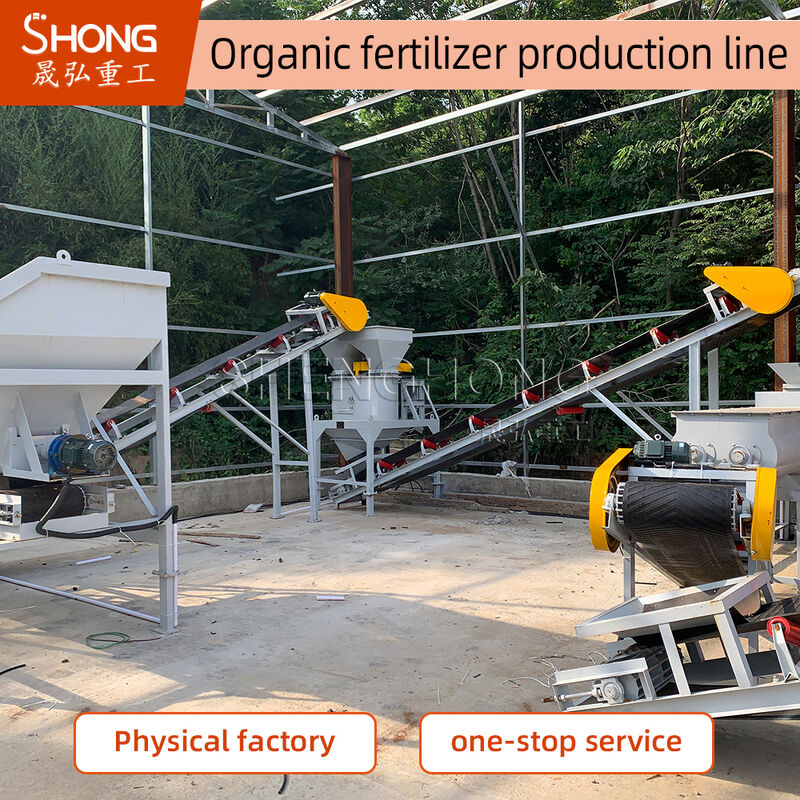
3-5t/H Capacity Poultry Manure Waste Bio Organic Fertilizer Production Line
The organic fertilizer production line is designed to process various fermented organic substances into high-quality bio-organic fertilizer. Utilizing advanced one-step molding technology, this system transforms animal manure and agricultural waste into valuable fertilizer products. This process not only generates economic benefits but also contributes significantly to environmental protection initiatives.
After proper safety disposal and fermentation, these materials are converted into organic fertilizer containing multiple organic acids, peptides, and essential nutrients including nitrogen, phosphorus, and potassium. This comprehensive nutritional profile supports crop growth while improving soil structure, promoting microbial activity, and enhancing soil physical and chemical properties.
| No. | Category | Raw Materials List |
|---|---|---|
| 1 | Agricultural waste | straw, dregs of beans, cotton dregs, rice bran, biogas waste, mushroom waste, etc. |
| 2 | Animal waste | slaughterhouse waste, fish market waste, urine and dung of chicken, pig, cattle, sheep ducks, geese, goat, etc. |
| 3 | Industrial waste | wine lees waste, vinegar waste, manioc waste, sugar waste, etc. |
| 4 | Home waste | food waste, bones, the roots and leaves of vegetables, etc. |
| 5 | Mineral | humic acid, bentonite, dolomite, etc. |
| 6 | Sludge | river sludge, pond sludge, sewage sludge, city sludge, etc. |
The organic fertilizer production line typically includes eight key processes: fermenting, grinding, mixing, granulating, drying, cooling, screening, and packaging. While fermenting, crushing, mixing, granulating, and screening are essential processes, others may be optional depending on production capacity requirements.
| No. | Processes | Machines | Function of Machines |
|---|---|---|---|
| 1 | Fermenting process | Fermentation turner | Mix and blend compost during fermentation evenly |
| 2 | Grinding process | Hopper for forklift | Feed compost into grinder evenly |
| Grinder | Grind compost to powder | ||
| 3 | Mixing process | Mixer | Mix compost powder evenly, add water, beneficial bacteria, or other micro-elements if necessary |
| 4 | Granulating process | Feeding machine | Feed mixed powder into granulator evenly |
| Granulator | Make mixed powder into fertilizer granules | ||
| 5 | Drying process | Dryer | Dry fertilizer granules to low moisture by hot air |
| Hot stove | Generate hot air to dryer | ||
| Cyclone | Collect dust from dryer | ||
| 6 | Cooling process | Cooler | Cool fertilizer granules to normal temperature |
| Cyclone | Collect dust from cooler | ||
| 7 | Screening process | Screener | Screen out required size from fertilizer granules |
| 8 | Packaging process | Air compressor | Generate power to packaging machine |
| Packaging machine | Package fertilizer granules into bags |
After proper safety disposal and fermentation, raw materials are transformed into bio-organic fertilizers containing various organic acids, peptides, and rich nutrients including nitrogen, phosphorus, and potassium. These organic fertilizers provide comprehensive nutrition for plants and crops while offering long-lasting fertilizer effects. The process enhances soil organic matter content, promotes microbial breeding, and improves soil chemical and physical properties along with biological activity.