logo

ZHENGZHOU SHENGHONG HEAVY INDUSTRY TECHNOLOGY CO., LTD. sales@gcfertilizergranulator.com 86--15286833220

ZHENGZHOU SHENGHONG HEAVY INDUSTRY TECHNOLOGY CO., LTD. Company Profile
Products
Home > Products > Compound Fertilizer Production Line > 200000 Tons/Year Capacity Compound Fertilizer Production Line with Ball Shape Granules and 12-15 Tons Per Hour Output

200000 Tons/Year Capacity Compound Fertilizer Production Line with Ball Shape Granules and 12-15 Tons Per Hour Output

Product Details

Place of Origin: Zhegzhou, Henan Province China

Brand Name: Shenghong

Certification: BV, SGS, ISO

Model Number: SH series

Payment & Shipping Terms

Minimum Order Quantity: 1 set

Price: can be negotiated

Packaging Details: Customer demand, usually in container

Delivery Time: 10-15 working days

Payment Terms: L/C,T/T

Supply Ability: 200 Sets Per Month

Get Best Price
Product Details
Highlight:

Compound Fertilizer Granulation Production Line

,

12T/H Compound Fertilizer Production Line

,

NPK Compound Fertilizer Production Machine

Capacity:
12-15 Tons Per Hour
Usage:
Making Fertilizer Granules
Raw Material:
NPK,Urea, Ammonium Nitrate, Etc.
Function:
Making NPK Compound Fertilizer
Granules Shapes:
Ball Shape
Guarantee:
12 Months
Capacity:
12-15 Tons Per Hour
Usage:
Making Fertilizer Granules
Raw Material:
NPK,Urea, Ammonium Nitrate, Etc.
Function:
Making NPK Compound Fertilizer
Granules Shapes:
Ball Shape
Guarantee:
12 Months
Product Description
200000 Tons/Year Compound Fertilizer Granulation Production Line Machinery
Factory Outlet 1000-200000 tons/year Compound Fertilizer Granulation Production Line Machinery
Granular dicalcium phosphate fertilizer making product line for sale
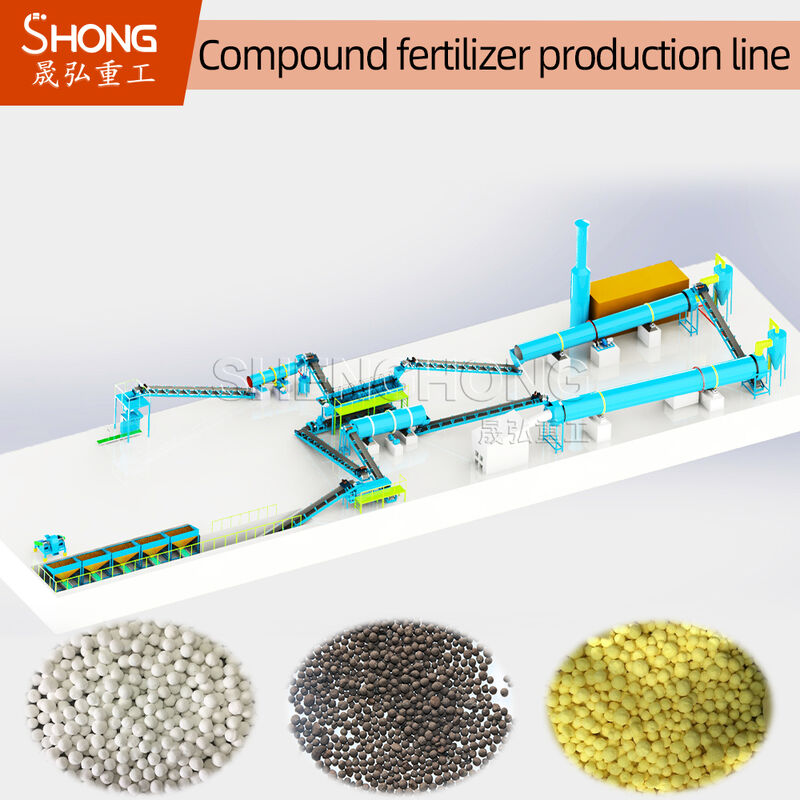
Compound fertilizer production line is widely applied to produce compound fertilizer with capacity ranging from 5,000-200,000 tons/year. This equipment can granulate NPK, NP, ANP, DAP, MAP, CAN, SSP and other materials into compound fertilizer particles in one processing line.
This machinery is specially designed for manufacturing compound fertilizers with different concentrations and types, including organic fertilizers, inorganic fertilizers, biological fertilizers and magnetic fertilizers. It primarily produces spherical particles with diameters ranging from 1mm to 3mm.
Compound fertilizer production line machinery overview
Key Advantages
  • Lower investment requirements with quick returns and excellent economic benefits
  • Compact, scientific, and advanced equipment process design
  • Energy efficient operation with reduced consumption and no waste removal
  • Stable and reliable operation with convenient maintenance
  • Wide raw material adaptability suitable for compound fertilizer, medicine, chemical industry, and feed granulation
  • High granulation rate for various compound fertilizer types
  • Leading domestic technology for tombarthite and ammonium carbide compound fertilizer production
Production Line Equipment Components
Loader Type Feeder
Raw material ingredients: Urea, ammonium nitrate, ammonium chloride, ammonium sulphate, ammonium phosphate (monoammonium phosphate, diammonium phosphate), coarse whiting, potassium chloride, potassium sulfate and other raw materials are proportionally matched according to market demand and soil test results.
Fertilizer Mixer
The ingredient mixture is thoroughly blended to ensure uniform fertilizer efficiency across all granules.
Fertilizer Granulator
The uniformly mixed raw materials are conveyed to the granulator. Both drum granulators and extruding granulators can be utilized in this process.
Fertilizer Drying and Cooling Machine
Granules are transferred to the dryer where moisture is removed, increasing granule strength and improving storage stability. After drying, cooling prevents clumping and facilitates bagging for storage and transportation.
Fertilizer drying and cooling equipment
Screen Machine Particle Classification
Cooled particles undergo grading: unqualified particles are crushed and regranulated, while qualified products are sifted out for final processing.
Packaging of Finished Product
Film-wrapped particles are stored in ventilated areas to maintain product quality and stability.