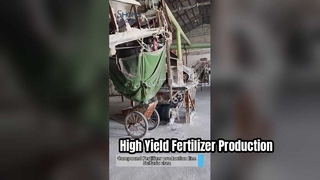
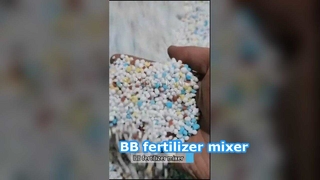
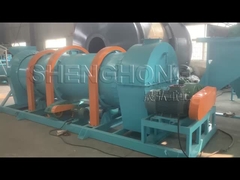
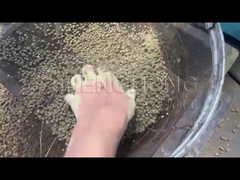
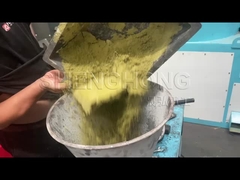
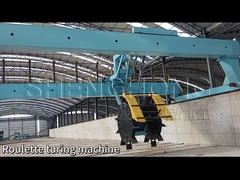
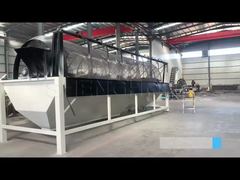
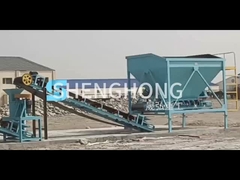
Brief: This video demonstrates the complete setup and operation of a high-capacity compound fertilizer rotary drum production line. You will see a step-by-step walkthrough of the entire process, from automatic batching and grinding to granulation, drying, cooling, and final packaging. The demonstration highlights how this plant efficiently produces 100,000 tons of spherical NPK fertilizer granules annually, showcasing its stable operation and flexibility with various raw materials.
Related Product Features:
Annual production capacity of 100,000 tons of compound fertilizer.
Produces uniform spherical particles with diameters between 1mm and 3mm.
Compatible with a wide range of raw materials including urea, ammonium sulfate, and various phosphates.
NPK content in the final product can be adjusted from 20% to 48%.
Utilizes a well-established production process for stable and efficient operation.
Can produce compound, organic, and organic compound fertilizers.
Features straightforward production formulas for ease of use and control.
Incorporates dust collection systems in drying and cooling processes for cleaner operation.
FAQs:
What is the annual production capacity of this fertilizer production line?
This rotary drum granulation plant has an annual production capacity of 100,000 tons of compound fertilizer.
What size of fertilizer particles does this production line produce?
The production line forms well-rounded, spherical particles measuring between 1mm and 3mm in diameter.
What types of raw materials can be used in this fertilizer production process?
The system is compatible with various raw materials including urea, ammonium sulfate, ammonium chloride, monoammonium phosphate, diammonium phosphate, single superphosphate, calcium magnesium phosphate, KCl, potassium sulfate, and K-Mag.
What is the NPK content range for fertilizers produced by this line?
The production line can produce fertilizers with NPK content ranging from 20% to 48%, adjustable based on market needs and soil test results.